



Adenosine Receptor
P1 receptor
Adenosine receptors (ARs) comprise a group of G protein-coupled receptors (GPCR) which mediate the physiological actions of adenosine. To date, four AR subtypes have been cloned and identified in different tissues. These receptors have distinct localization, signal transduction pathways and different means of regulation upon exposure to agonists. A key property of some of Adenosine receptors is their ability to serve as sensors of cellular oxidative stress, which is transmitted by transcription factors, such as NF-κB, to regulate the expression of ARs. The importance of Adenosine receptors in the regulation of normal and pathological processes such as sleep, the development of cancers and in protection against hearing loss will be examined.
Adenosine Receptor Isoform Specific Products
All Product Categories
-
Adenosine Receptor Inhibitors
(41)
View all products
-
Adenosine Receptor Agonists
(119)
View all products
-
Adenosine Receptor Antagonists
(203)
View all products
-
Adenosine Receptor Activators
(9)
View all products
-
Adenosine Receptor Modulators
(11)
View all products
-
Adenosine Receptor Degrader
(1)
View all products
-
Adenosine Receptor Ligands
(13)
View all products
-
Adenosine Receptor Related Products (428)
Related Products (428)

-
Antibodies (2)
-
Adenosine Receptor Isoform Comparison
-
CVT-5440
 0 ImagesCat. No.: HY-123038CAS No.: 531506-64-6CVT-5440 is a xanthine based, selective, high affinity A2B adenosine receptors (AdoR) antagonist with a Ki of 50 nM (selectivity A1> 200; A2A>200; A3>167). CVT-5440 has the potential for asthma research.
-
SCH 58261 (Standard)
 0 ImagesSCH 58261 (Standard) is the analytical standard of SCH 58261. This product is intended for research and analytical applications. SCH 58261 is a potent, selective and competitive antagonist of adenosine A2A receptor with an IC50 of 15 nM, and displays 323-, 53- and 100-fold more selective for A2A receptor than A1, A2B, and A3 receptors, respectively.

-
MRS1067
 0 ImagesCat. No.: HY-118086CAS No.: 70460-45-6MRS 1067 is a competitive antagonist of the adenosine A3 receptor that inhibits the suppression of adenylate cyclase by adenosine A3 receptor agonists and affects the activation of G proteins. MRS 1067 can be used in research related to inflammation and cancer.
-
Xanthine amine congener hydrochloride (Standard)
 0 ImagesCat. No.: HY-101139ARCAS No.: 1783977-95-6Synonyms: XAC hydrochloride (Standard)Xanthine amine congener (hydrochloride) (Standard) is the analytical standard of Xanthine amine congener (hydrochloride). This product is intended for research and analytical applications. Xanthine amine congener (XAC) hydrochloride is a non-selective adenosine receptor antagonist. Xanthine amine congener hydrochloride induces convulsions in mice.
-
PSB-1115 potassium salt
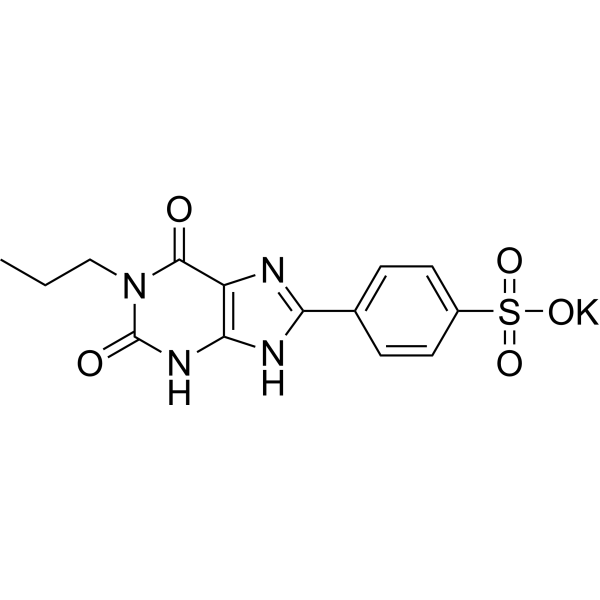 0 ImagesCat. No.: HY-103182ACAS No.: 409344-71-4PSB-1115 potassium salt is a selective A2B Adenosine Receptor antagonist. PSB-1115 potassium salt inhibits the 2,4,6-trinitrobenzenesulfonic acid (TNBS)-induced contraction inhibition of acetylcholine (ACh).
-
Preladenant (Standard)
 0 ImagesCat. No.: HY-10889RCAS No.: 377727-87-2Synonyms: SCH-420814 (Standard)Preladenant (Standard) is the analytical standard of Preladenant. This product is intended for research and analytical applications. Preladenant is a potent and competitive antagonist of the human adenosine A2A receptor with a Ki of 1.1 nM and has over 1000-fold selectivity over other adenosine receptors.
-
N6-Cyclopentyladenosine (Standard)
 0 ImagesCat. No.: HY-103181RCAS No.: 41552-82-3Synonyms: CPA (Standard); UK-80882 (Standard)N6-Cyclopentyladenosine (Standard) is the analytical standard of N6-Cyclopentyladenosine (HY-103181). This product is intended for research and analytical applications. N6-Cyclopentyladenosine (CPA) is a selective Adenosine A1 receptor agonist, with Ki values of 2.3 nM, 790 nM and 43 nM for human A1, A2A and A3 receptors, respectively. N6-cyclopentyladenosine increases Apoptosis. N6-Cyclopentyladenosine has antitumor activity against leukemia. N6-cyclopentyladenosine improves 5-fluorouracil (HY-90006)-induced hematopoietic damage, regulates sleep, and delays Aminophylline-induced clonic epileptic seizures.
-
CGH2466 dihydrochloride
 0 ImagesCat. No.: HY-103167CAS No.: 1177618-54-0CGH 2466 dihydrochloride is an orally active adenosine A1, A2B and A3 receptor antagonist with the IC50 values of 19 nM, 21 nM, and 80 nM respectively. CGH 2466 dihydrochloride inhibits p38 MAPK (IC50 = 187~ 400 nM) and phosphodiesterase type 4D (IC50 = 22 nM). CGH 2466 dihydrochloride displays potent anti-inflammatory effects both in vitro and in vivo, and can be used for research on asthma and chronic obstructive pulmonary disease (COPD).
-
ATL-802
 0 ImagesCat. No.: HY-111306CAS No.: 847612-12-8ATL-802 is a potent adenosine A2B receptor antagonist. ATL-802 is promising for research of diabetes.
-
BAY 60-6583 (Standard)
 0 ImagesBAY 60-6583 (Standard) is the analytical standard of BAY 60-6583. This product is intended for research and analytical applications. BAY 60-6583 is a potent and high-affinity agonist of adenosine A2B receptor (EC50?= 3 nM) over A1, A2A, and A3 receptors. BAY 60-6583 binds to mouse, rabbit, and dog A2BAR with Ki values of 750 nM, 340 nM and 330 nM, respectively. BAY 60-6583 has a cardioprotective effect in a myocardial ischemia model.
-
Vipadenant (Standard)
 0 ImagesSynonyms: BIIB-014 (Standard); CEB-4520 (Standard)Vipadenant (Standard) is the analytical standard of Vipadenant. This product is intended for research and analytical applications. Vipadenant (BIIB-014; CEB-4520) is an adenosine receptor antagonist, with Kis of 1.3 nM and 68 nM for A2A and A1, respectively.
-
Tozadenant (Standard)
 0 ImagesCat. No.: HY-10995RCAS No.: 870070-55-6Synonyms: SYN115 (Standard)Tozadenant (Standard) is the analytical standard of Tozadenant (HY-10995). This product is intended for research and analytical applications. Tozadenant is an adenosine A2A receptor antagonist, with Ki of 11.5 nM on human A2A and 6 nM on rhesus A2A.
-
PD81723
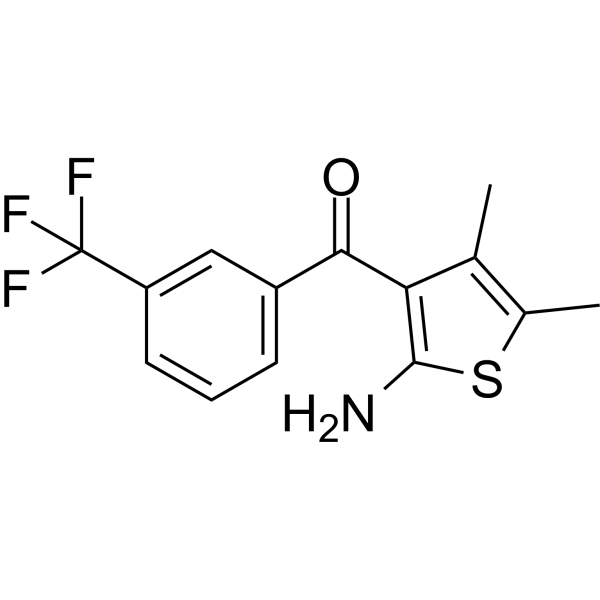 0 ImagesPD81723 is an adenosine receptor binding enhancer. PD81723 enhances the inhibition of exogenous adenosine in a dose-dependent manner in hippocampal brain sections.
-
Adenosine receptor agonist 1
 0 ImagesCat. No.: HY-162851Adenosine receptor agonist 1 (compound 6m) is an A3 adenosine receptor (AR) partial agonist with Ki value of 6.7 nM.
-
7-Methylxanthine (Standard)
 0 Images7-Methylxanthine (Standard) is the analytical standard of 7-Methylxanthine. This product is intended for research and analytical applications. 7-Methylxanthine is an orally active methyl derivative of xanthine and a non-selective adenosine receptor antagonist. 7-Methylxanthine is also one of the purine components of human urinary calculi. 7-Methylxanthine has anti-myopia activity.
-
Aminophylline (Standard)
 0 ImagesAminophylline (Standard) is the analytical standard of Aminophylline (HY-B0140). This product is intended for research and analytical applications. Aminophylline is a competitive phosphodiesterase 3/4 (PDE3/4) inhibitor. Aminophylline also acts as an adenosine receptor antagonist. Aminophylline elevates intracellular cAMP levels via competitive inhibition of PDE3 and PDE4, antagonizes adenosine A1 receptor (ADORA1), regulates intracellular calcium signaling and synaptic vesicle cycling, upregulates the PPAR signaling pathway, and downregulates glutamatergic synaptic pathways simultaneously. Aminophylline can be used in research related to major depressive disorder, epilepsy, asthma, and chronic obstructive pulmonary disease (COPD).
-
Diphylline (Standard)
 0 ImagesDiphylline (Standard) is the analytical standard of Diphylline. This product is intended for research and analytical applications. Diphylline (Diprophylline) is a potent A1/A2 adenosine receptor antagonist and cyclic nucleotide phosphodiesterase inhibitor. Diphylline, a xanthine derivative, is a bronchodilator and vasodilator agent and has the potential for chronic bronchitis and emphysema.
-
ADORA1 modulator-1
 0 ImagesCat. No.: HY-180879CAS No.: 820961-65-7ADORA1 modulator-1 is an ADORA1 modulator.
-
CP-66713
 0 ImagesCat. No.: HY-111129CAS No.: 91896-57-0CP-66713 is a selective adenosine A2 receptor antagonist, with Ki of 22 nM. CP-66713 inhibits induction of long-term potentiation of evoked synaptic potentials. CP-66713 can be used in the study of neurological diseases.




